By subscribing you agree to with our Privacy Policy and provide consent to receive updates from our company.
Business Insight
AI
From Trash to Tech: How AETech Turns Waste into Intelligent Solutions
Asia Tomorrow Original
January 7, 2026
Inside the South Korean startup revolutionizing waste management with AI-powered robotics.
Source: korea.net
South Korea’s cities wrestle with mounting waste volumes and rising recycling inefficiencies. Traditional systems—heavily reliant on manual labor—struggle with accuracy, safety, and speed. Into this gap steps AETech, a startup using AI and robotics to transform waste from an urban burden into a valuable resource stream.
Genesis and Vision
Founded in 2020 by graduates of Seoul National University’s mechanical engineering program, AETech was built on the mission of achieving “perfect automation.” Its vision: smart cities where robotic systems don’t just sort trash efficiently, but unlock resources within it—turning urban centers into “urban mines” and minimizing landfill dependency.
The Challenge
Key barriers in the sector demanded new approaches:
High contamination rates in mixed waste streams undermining recycling outcomes
Labor shortages and safety risks for manual waste sorters
Cultural complexity, with certain local waste types proving hard for generic systems to recognize
These challenges created space for AI-driven precision.
Source: smartcity.go.kr
AI-Powered Innovation
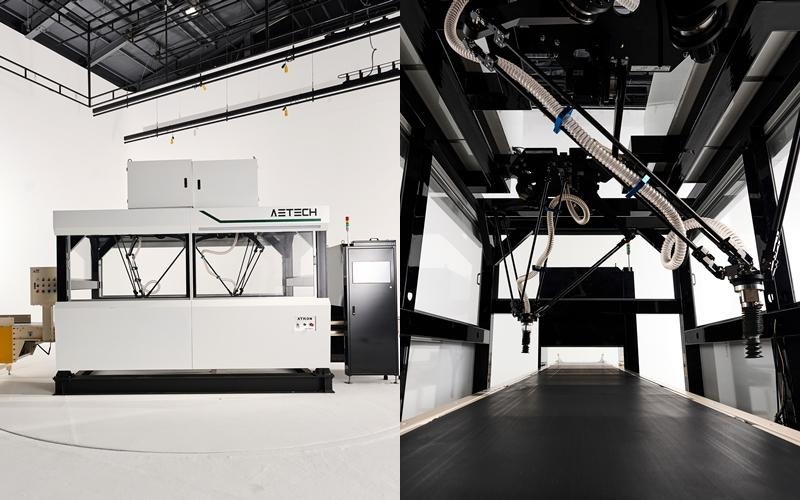
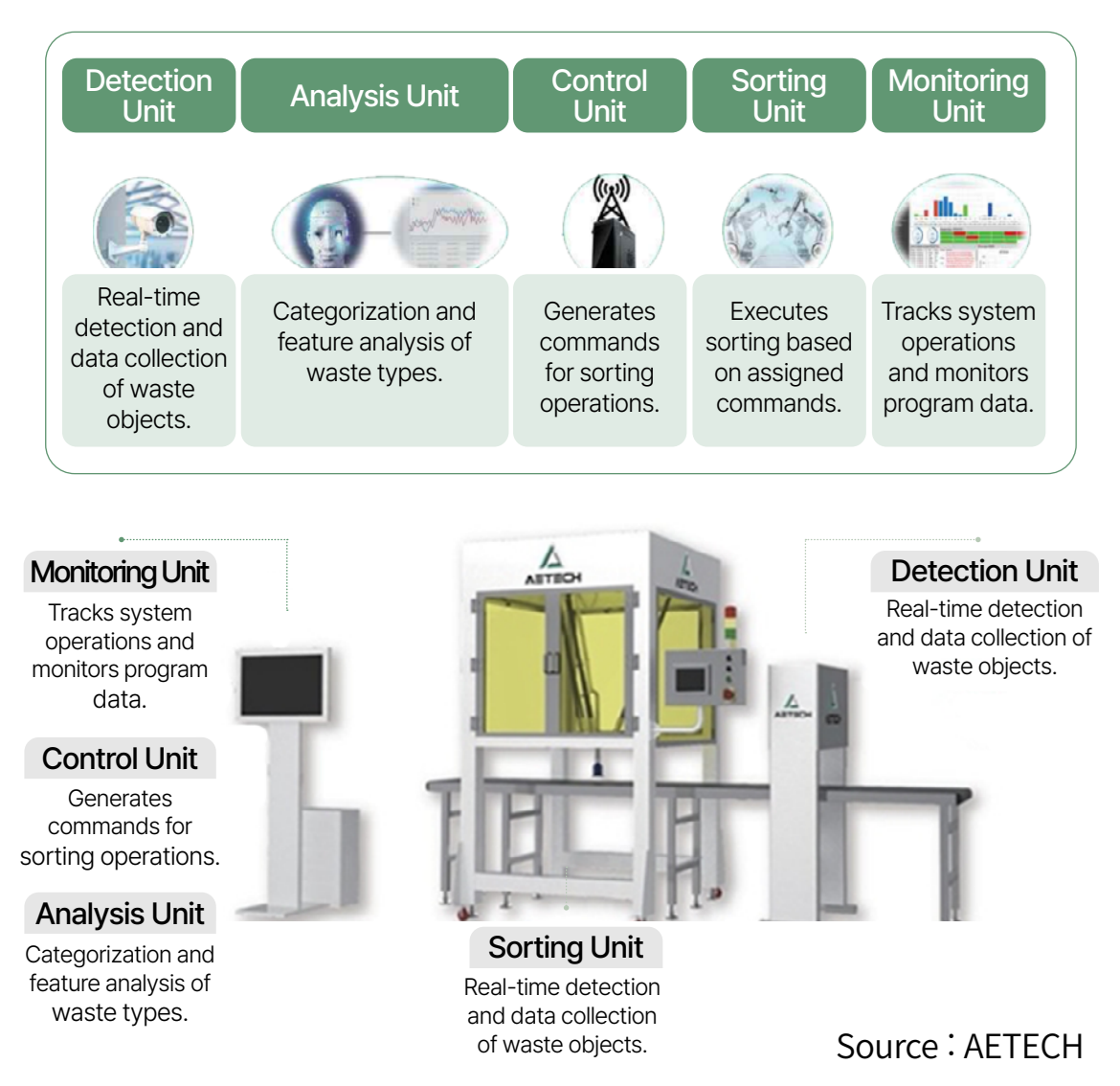
AETech’s flagship, Atron, is an AI-driven sorting robot that classifies and separates waste autonomously. Trained on more than 2.8 million real-world data samples, Atron can sort up to 96 items per minute with 99.3% accuracy—recognizing 43 subcategories of waste, from plastics to paper, with distinctions by color, material, and texture.
Core technologies include:
Vision cameras + deep learning for real-time waste recognition
Robotic arms with suction grip tech for rapid, precise picking
Continuous data tracking, feeding back into AI to sharpen performance over time
AETech has also built complementary systems:
wai-kor, an algorithm fine-tuned for Korea’s culturally specific waste (e.g., traditional food containers)
Airo-MRF, a modular, fully automated materials recovery facility with 30+ Atron units. It achieves 70–80% recovery rates (versus 30–40% in manual facilities) and cuts annual carbon emissions by over 9,000 tons
Multi-Tron, optimized for large public facilities, improving both speed and efficiency
Impact and Scaling
The results are significant:
Recycling efficiency up by 240% per facility
Operational costs reduced by nearly 280%
Processing time cut by 126%
Worker exposure to hazardous sorting eliminated
With 20+ Atron units already in operation and major Airo-MRF facilities underway in cities like Incheon, AETech has drawn recognition at home and abroad, from Korea’s NextRise 2025 Innovator Award to the WIPO Global Award. Partnerships with SK Ecoplant, Lotte Chemical, and global players in Australia, Singapore, and Vietnam are extending its reach.
Strategic Lessons and Future Outlook
AETech KR’s success underscores:
The power of deep collaboration between academia and industry to solve environmental challenges
The necessity of culturally adapted AI models for waste management effectiveness
The scalability of AI-driven robotic solutions for global adoption
Looking ahead, AETech plans to expand into industrial and marine waste sorting applications and enhance its smart city vision globally through participation in international expos such as CES 2025. The company aims to lead the worldwide transformation toward sustainable, autonomous waste processing.

.svg)




0 Comments